

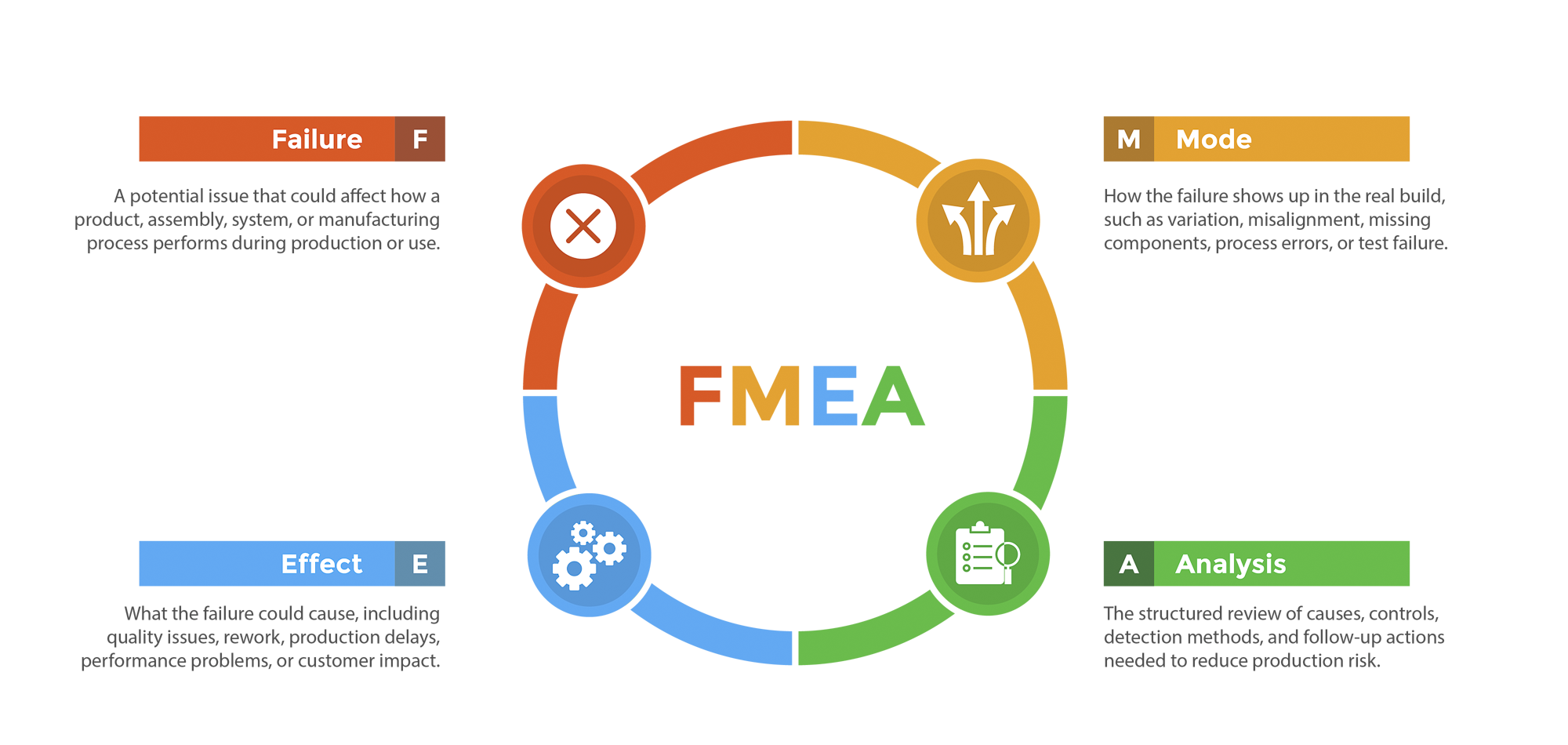
Failure mode and effects analysis, or FMEA, is a structured risk assessment method used to identify how a product, system, design, or process could fail before those failures create quality, safety, performance, production, or customer acceptance issues.
For OEMs, FMEA is most useful when it moves beyond a worksheet and becomes a practical decision-making tool. A good FMEA helps teams understand what could go wrong, why it could happen, how severe the effect could be, what controls already exist, and what actions may reduce the risk.
FMEA can support product development, new product introduction, production readiness, manufacturing engineering, production transfer, quality planning, test planning, and long-term manufacturing support. It can also help engineering and manufacturing teams communicate more clearly about design risks, process risks, system-level interactions, and production controls.
What Is FMEA in Manufacturing?
FMEA stands for failure mode and effects analysis.
A failure mode is the way a product, component, system, or process could fail. An effect is what happens if that failure occurs. The analysis reviews those potential failures, evaluates their causes and consequences, and helps prioritize where action is needed.
In a manufacturing context, FMEA may be used to answer questions such as:
- How could this component fail?
- What could cause a process step to create defects?
- What happens if a subsystem does not perform its required function?
- How could an assembly operation introduce variation?
- Are current inspection or test controls sufficient?
- What risks should be addressed before production release or transfer?
The goal is not to predict every possible issue. The goal is to identify the most important risks early enough to reduce their likelihood, improve detection, or limit their impact.
Why OEMs Use FMEA
OEMs use FMEA to reduce preventable risk before a product or process moves too far downstream. When FMEA is performed early and updated as the program matures, it can help prevent issues from reaching production, the customer, or the field.
FMEA can help OEM teams:
- Identify potential design, system, process, assembly, or test failures
- Prioritize risks based on severity, occurrence, and detection
- Improve product and process controls
- Support design review and manufacturability planning
- Strengthen inspection and test requirements
- Inform control plans and work instructions
- Reduce rework, scrap, delays, and quality escapes
- Support production readiness and manufacturing transfer
For complex machinery, equipment, assemblies, and electromechanical systems, FMEA is especially useful because risks often cross functional boundaries. A design feature may affect sourcing. A material choice may affect manufacturability. A tolerance may affect assembly. A test gap may affect final acceptance.
Common Types Of FMEA
FMEA can be applied at different levels depending on what needs to be reviewed. For OEM manufacturing programs, three of the most common forms are DFMEA, PFMEA, SFMEA.
What is DFMEA?
DFMEA stands for design failure mode and effects analysis. It focuses on design-related risks before the product moves into production.
Design FMEA may evaluate component selection, material choices, dimensional requirements, geometric tolerances, interfaces, operating conditions, design assumptions, and the effects of design-related failures.
It may be useful when an OEM needs to review:
- Whether a design can meet functional requirements
- Whether component or material choices introduce risk
- Whether tolerances are appropriate for manufacturing and assembly
- Whether interfaces between parts are clearly defined
- Whether design changes could affect performance, inspection, or test
DFMEA is often used during product development, design review, new product introduction, engineering change review, and design transfer.
What is PFMEA?
PFMEA stands for process failure mode and effects analysis. It focuses on how the manufacturing or assembly process could introduce defects or variation.
Process FMEA may review process steps, assembly sequence, operator inputs, tooling, fixtures, equipment, work instructions, inspection points, process controls, and test requirements.
It may be useful when an OEM needs to understand:
- How a process step could fail
- How assembly errors could occur
- Whether inspection points are sufficient
- Whether fixtures or tooling introduce risk
- Whether operator inputs or work instructions need clearer controls
- Whether production transfer could introduce process variation
PFMEA is often used during manufacturing engineering, process planning, production readiness review, production transfer, control plan development, and ongoing manufacturing improvement.
What is SFMEA?
SFMEA stands for system failure mode and effects analysis. It looks at the product, machine, equipment platform, or assembly at the system level.
Rather than focusing only on individual parts, system FMEA evaluates how major functions, subsystems, interfaces, controls, operating conditions, and assemblies interact. This is useful when a failure in one part of the system could affect the performance of another part of the system.
It may be used for:
- Complex machinery
- Electromechanical systems
- Integrated equipment
- Test platforms
- Assemblies with multiple interacting subsystems
- Products with mechanical, electrical, controls, pneumatic, or software interfaces
For example, an SFMEA may consider what happens if a sensor does not provide the expected signal, if a motion subsystem does not respond correctly, or if an interface between two assemblies creates a system-level failure.
DFMEA Vs. PFMEA Vs. SFMEA
Design FMEA, process FMEA, and system FMEA are related, but they answer different questions.
DFMEA asks: “How could the design fail, and what design choices could affect product performance, reliability, manufacturability, or customer acceptance?”
PFMEA asks: “How could the manufacturing or assembly process fail, and what process controls are needed to prevent or detect defects?”
SFMEA asks: “How could the system fail, and how could failures move across functions, subsystems, or interfaces?”
For complex OEM programs, these reviews may inform each other. A design risk identified in DFMEA may need to be addressed in a PFMEA through added process controls or inspection steps. A process risk found during PFMEA may reveal a design feature that should be reconsidered. A system-level issue found during SFMEA may affect both design and process planning.
Approaches To FMEA Development
FMEA can also be approached in different ways depending on the product stage, available information, and level of detail needed. Three useful approaches are functional FMEA, interface FMEA, and detailed FMEA.
Functional FMEA
A functional FMEA focuses on what the product, system, process, or service is supposed to do. Instead of starting with individual parts or process steps, the analysis begins with required functions.
This approach is useful early in development when detailed hardware, component, or process information may not be finalized. It is also useful for complex systems that are easier to evaluate by function before looking at lower-level implementation details.
For example, a functional FMEA may review whether a system fails to move, fails to heat, fails to stop, fails to detect, or fails to communicate.
Interface FMEA
An interface FMEA focuses on the connections between system elements. This may include mechanical linkages, electrical cabling, pneumatics, hydraulics, signals, software communication, data connections, or other interfaces between subsystems.
This approach is useful when system performance depends on how components or subsystems interact. Interface-related failures can be difficult to catch if teams only review individual parts or individual process steps.
For OEM machinery and electromechanical equipment, interface FMEA can be especially important because failures often occur at handoffs between mechanical, electrical, controls, pneumatic, software, or operator-facing elements.
Detailed FMEA
A detailed FMEA focuses on specific implementation details after parts, process steps, software routines, or assemblies are more clearly defined.
This approach may evaluate lower-level items such as individual components, piece parts, manufacturing steps, equipment settings, work instructions, inspection methods, or test procedures. It is often more practical later in design and development when the product architecture and manufacturing process are more mature.
Detailed FMEA is useful when teams need to verify that the final design or production process has adequate controls before release, transfer, or ramp.
When To Use Each FMEA Approach
The right approach depends on the stage of the program and the risks being reviewed.
A functional approach is often useful early, when teams need to understand what the product or system must do. An interface approach is useful when interactions between subsystems, assemblies, controls, or process steps create risk. A detailed approach is useful when the team is ready to review specific components, tolerances, process steps, controls, and verification methods.
Many complex OEM programs use more than one approach. A team may begin with system-level or functional risk, then move into interface review, and later develop more detailed design or process FMEAs as the product and manufacturing plan mature.
How FMEA Supports Manufacturing Readiness
FMEA supports manufacturing readiness by connecting risk assessment to the controls needed for production. Once risks are identified, teams can determine whether they need design changes, process updates, inspection steps, test requirements, supplier actions, work instruction updates, or additional documentation.
In OEM manufacturing programs, FMEA may support:
- Design review before production release
- Manufacturing engineering and process planning
- Production readiness review
- Production transfer
- Control plan development
- Inspection and test planning
- Assembly process development
- Supplier or purchased component review
- Quality planning
- Corrective action and continuous improvement
The value of FMEA is not simply that it documents risk. Its value comes from turning risk into action before the issue affects production.
Need FMEA Risk Assessment Support?
FMEA is most useful when risk review leads to practical engineering and manufacturing action. PEKO supports FMEA risk assessment as part of broader new product introduction and contract manufacturing programs.
Because PEKO’s engineering and manufacturing teams support the full production path, FMEA can be tied directly to how the product will be built, inspected, tested, documented, and supported in production.
Contact us today to learn more about our FMEA risk assessment support.