

A promising product can lose momentum long before there is anything wrong with the design itself. Engineering capacity gets stretched. Build space becomes limited. Suppliers that worked for the first prototype may not support the next phase. Test resources arrive too late. Technical information becomes harder to control as more people and partners get involved.
Good product development planning helps prevent those constraints from slowing the program down. It looks beyond the next engineering milestone and considers what people, resources, infrastructure, suppliers, and manufacturing support will be needed as the product moves closer to production.
Whether those capabilities sit internally, with outside specialists, or across both, effective product development best practices help teams anticipate what the program will need next and put the right support in place before those needs become larger product development challenges.
Product Development Team Structure: Match Responsibilities to the Work
The first question is not simply how many engineers a program needs. It is what work needs to be done, which disciplines need to be involved, and where responsibility for key decisions should sit.
For complex mechanical, electrical, and electromechanical products, the product development team structure may span product engineering, controls, manufacturing engineering, sourcing, quality, test, technicians, and program management.

Those functions do not all need to sit inside the OEM. What matters is that product ownership and technical authority remain clear while supporting responsibilities are assigned to the people best equipped to handle them.
A team may have deep expertise in controls, software, electronics, optics, or another core technology without carrying the same depth in fabrication, assembly, sourcing, test, or manufacturing engineering. The product development team structure should account for those gaps so specialists can stay focused on the technology they uniquely own while other responsibilities are assigned to internal or external resources with the right experience.
PEKO often supports those surrounding activities such as manufacturing engineering, DFM/DFA, sourcing, and build support as an extension of the OEM team while the customer retains ownership of the product, requirements, and technical direction.
Product Development Resource Planning: Prepare for the Next Stage
Once responsibilities are clear, the new product planning process can shift from defining who owns the work to determining whether the program has enough capacity to execute it.
That is the role of product development resource planning. The resource mix that works during design may not be enough once prototype builds, testing, sourcing, and manufacturing activity increase.
Instead of staffing for every possible future need, teams can plan for when additional capacity will be required. That may mean adding engineering bandwidth, assigning more build or test support, increasing program-management attention, or bringing in outside specialists when internal resources are already committed elsewhere.
Useful questions include:
- Which functions are likely to become capacity constraints?
- When will build and test activity require more support?
- Which resources are dedicated to the program, and which are shared?
- Where can outside expertise or manufacturing support fill a temporary or long-term gap?
- How will resource needs change as build quantities increase?
Good NPD planning keeps the program from reaching a new stage before the people and capacity needed to support it are available.
Plan Manufacturing Infrastructure Before Build Demand Grows
Once the team and resource capacity are accounted for, the planning shifts to the physical environment required to execute the work.
A lab or flexible engineering area may support early builds, but that setup can become limiting as products grow in size, multiple units move through the build at once, or manufacturing becomes more controlled.
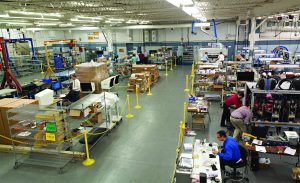
Depending on the product, infrastructure planning may need to account for:
- assembly and integration space
- electrical power and utilities
- material handling
- receiving and storage
- test areas
- tooling and fixtures
- environmental requirements
- room for multiple builds in process
The key is to look beyond the next unit. As build demand grows, space, equipment, test capacity, and material flow can become constraints even when the engineering team itself is well staffed.
An OEM does not need to own all of the required infrastructure. The program simply needs a clear plan for where those physical resources will come from—internally, through outside partners, or through a combination of both.
Define IP, Documentation & Change-Control Ownership
Planning also needs to cover the information behind the hardware.
A well-defined new product development planning process should also establish how technical information will be owned, maintained, approved, and transferred as more people and organizations become involved.
Questions to settle early include:
- Where do the master files live?
- Who can approve engineering changes?
- How are revisions communicated?
- What work product must be returned to the OEM?
- What happens to the documentation if a supplier changes?
This is especially important when outside engineering or manufacturing resources are involved.
At PEKO, the approach is straightforward: the OEM retains ownership of its product, and product designs, drawings, documentation, and related work developed for the customer become customer property.
Clear ownership helps the OEM maintain control of the product even as different teams contribute to its development and manufacturing.
Plan the Supplier and Manufacturing Strategy Beyond the Next Build
Development suppliers are often chosen because they solve an immediate need. A specialized shop may be ideal for an early component. A design firm may fill a technical gap. A distributor may supply parts quickly for a small number of builds.
The important question is whether that supplier structure still works as the product matures.
Later-stage requirements may include greater capacity, repeatable quality, revision control, component availability, inspection, traceability, production pricing, and more predictable lead times. A supplier that works well for development may not be the right fit for pilot or recurring production.
That strategy should also account for where future production capacity will come from. Forecasted build quantities, capital needs, floor space, equipment, staffing, and supplier-management requirements can all affect whether an internal, outsourced, or hybrid manufacturing model makes sense.
Effective new product development planning considers which supplier relationships can scale, which are likely to change, what technical information will need to transfer, and how the program will support later-stage production requirements.
Product Development Best Practices That Keep Planning Practical
The most useful product development best practices are the ones that help teams anticipate what the program will need as the product matures.
For complex physical products:
- Match resources to the product’s current maturity and next stage.
- Keep core product knowledge and design authority with clear owners.
- Bring manufacturing resources in before they become urgently needed.
- Plan physical infrastructure around future build requirements, not just the next unit.
- Decide deliberately what should remain internal and what can be supported externally.
- Establish control of technical information before multiple teams begin generating it.
- Evaluate suppliers with later-stage manufacturing requirements in mind.
These best practices for product development do not make every decision predictable. They give the team a clearer framework for adjusting resources, responsibilities, infrastructure, and manufacturing support as new information emerges.
Connect New Product Development Planning into NPI Execution
Product development planning is most useful when it leads to clear action. Once the team understands the resources, infrastructure, technical ownership, supplier needs, and manufacturing support required, those decisions can be translated into an NPI roadmap that reflects the product’s actual maturity.
At PEKO, that starts with assessing the current state of the product—available documentation, functional requirements, prototype status, production objectives, schedule, expected volumes, and known risks. From there, the program can be structured around the engineering and manufacturing work still needed to move forward.
 PEKO supports OEMs through New Product Introduction, including product development engineering, prototype development, pilot production, and manufacturing scale-up. With 40 engineers and 60 years of manufacturing experience, PEKO can support programs at different stages while keeping engineering and manufacturing closely connected.
If your team is assessing what is already in place and what may still be missing, PEKO’s NPI Self-Assessment Checklist can help review the engineering and manufacturing factors that should be considered as a product moves toward structured NPI and production.