

Turnkey manufacturing helps OEMs move beyond fragmented parts sourcing by giving one qualified partner responsibility for the build process, from sourcing and fabrication through assembly, testing, and delivery.
As OEM products become more complex, sourcing individual parts can create more work than it solves. What starts as a manageable bill of materials (BOM) can become a growing network of suppliers, purchase orders, subassemblies, inspection requirements, missing components, and internal assembly labor.
For some programs, buying parts from multiple vendors still makes sense. But when supplier coordination starts slowing production, increasing quality risk, or consuming too much internal capacity, it may be time to consider whether turnkey contract manufacturing offers a more controlled path to completed assemblies, equipment, or integrated systems.
What Are Turnkey Manufacturing Services?
Turnkey manufacturing services allow an OEM to outsource a larger portion of the production process to a qualified manufacturing partner. Instead of sourcing individual parts from multiple suppliers and assembling them internally, the OEM provides the design files, technical documentation, specifications, and requirements. The manufacturing partner then manages the work required to deliver the finished build.
Depending on the program, turnkey contract manufacturing may include:
- BOM review and sourcing
- Supplier coordination
- CNC machining
- Sheet metal fabrication
- Welding and finishing
- Mechanical assembly
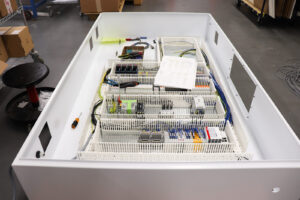
- Electrical or electromechanical assembly
- Cable routing, wiring, and controls integration
- Inspection, documentation, and traceability
- Functional testing or final acceptance testing
- Packaging and shipment
The goal is not simply to buy parts from a different supplier. The goal is to shift responsibility for a larger portion of the manufacturing and assembly workflow to a partner that can manage it with the right systems, people, and controls.
Parts Sourcing vs. Turnkey Contract Manufacturing
In a traditional parts-sourcing model, the OEM purchases components from multiple vendors and remains responsible for coordinating the full production path. Internal teams may need to manage sourcing, supplier communication, incoming inspection, inventory, kitting, assembly labor, quality issues, and production delays.
In a turnkey contract manufacturing model, the OEM still owns the product design and requirements, but the manufacturing partner takes responsibility for more of the execution. That may include procuring parts, manufacturing custom components, managing outside processes, assembling the product, testing the build, and delivering a completed assembly.
| Model | OEM Manages | Manufacturing Partner Manages |
|---|---|---|
| Parts Sourcing | Multiple suppliers, purchase orders, inventory, internal assembly, supplier follow-up, and production coordination | Individual parts or limited manufacturing scope |
| Turnkey Manufacturing | Product requirements, design ownership, approval, and program direction | Sourcing, manufacturing, assembly, integration, inspection, testing, and delivery of the completed build |
For complex OEM programs, that shift can reduce internal workload and improve production control.
When Parts Sourcing Starts Creating Problems
Sourcing individual parts can work well when the BOM is simple, production volumes are predictable, and internal assembly resources are available. It becomes harder to manage when the product involves many custom parts, long-lead components, frequent engineering changes, multiple suppliers, and labor-intensive assembly.
Common signs that parts sourcing is becoming a bottleneck include:
- Purchasing teams are managing too many vendors and purchase orders.
- Internal teams are spending too much time expediting parts.
- Production is delayed by missing hardware, brackets, cables, fasteners, or fabricated components.
- Engineering and operations teams are pulled into supplier coordination instead of product improvement.
- Incoming inspection issues are increasing.
- Internal assembly labor is constrained.
- Quality problems are discovered late in the build.
- Finished assemblies are difficult to reproduce consistently.
When these issues become routine, the lowest piece-part price may no longer represent the lowest total cost. The hidden costs of coordination, inspection, inventory, rework, schedule risk, and lost engineering time can become significant.
Why OEMs Move to Turnkey Manufacturing
OEMs typically move to turnkey manufacturing when they need more control, fewer supplier handoffs, and a more efficient path to completed builds.
Fewer Suppliers to Manage
A turnkey partner can reduce the number of suppliers an OEM needs to coordinate directly. Instead of issuing separate purchase orders for fabricated parts, machined components, hardware, wiring, finishing, assembly, and testing, the OEM can consolidate more of that work under one partner.
This can simplify communication, reduce administrative work, and make it easier to understand who is responsible when issues arise.
Simpler Purchasing Workflows
Turnkey manufacturing can also reduce the burden on purchasing teams. Instead of managing dozens or hundreds of individual line items, buyers may be able to purchase a completed assembly, subsystem, or equipment build under a more consolidated purchasing structure.
That does not eliminate the need for supplier management, but it can reduce repetitive purchase order activity, supplier follow-up, quote comparisons, and expediting.
Better BOM and Inventory Control
Complex builds depend on accurate BOMs, controlled revisions, and reliable material flow. A turnkey partner with strong sourcing and production systems can help manage long-lead items, supplier constraints, revision changes, shortages, and assembly sequencing.
This is especially important when a finished assembly depends on many custom and purchased components arriving at the right time.
Less Internal Assembly Labor
Many OEMs do not want their internal engineering or operations teams spending time on repeatable assembly work that could be handled by a manufacturing partner. Turnkey assemblies can arrive ready for installation, integration, shipment, or higher-level production.
That allows internal teams to focus on product design, customer requirements, final system integration, or strategic production work.
Improved Accountability
When multiple suppliers are involved, it can be difficult to determine where a problem started. Was it a machining issue, fabrication issue, supplier delay, assembly error, documentation gap, or inspection miss?
A turnkey model creates clearer accountability. One partner is responsible for managing the manufacturing and assembly process and delivering the completed build to the agreed requirements.
More Consistent Builds
Repeatability matters for complex assemblies. A qualified turnkey manufacturing partner should use controlled work instructions, trained technicians, inspection steps, documentation, and testing procedures to help ensure the build can be repeated consistently over time.
When Turnkey Manufacturing Makes Sense
Full turnkey manufacturing may be a good fit when an OEM is building complex products that require more than simple component purchasing. This model is often most valuable when sourcing, fabrication, assembly, inspection, testing, and delivery all need to be coordinated through a controlled manufacturing process.
Full turnkey manufacturing is often useful for:
- Complex machinery and equipment
- Electromechanical assemblies
- High-level assemblies and box builds
- Industrial equipment and production systems
- Test equipment and instrumentation
- Fabricated frames, enclosures, and integrated structures
- Low- to mid-volume OEM production programs
- Programs with sourcing, assembly, testing, and documentation requirements
A turnkey model can be especially valuable when the OEM has a mature design but needs a stronger manufacturing path, or when internal teams are stretched by supplier coordination, assembly labor, or production transfer.
When Parts Sourcing May Still Be the Better Fit
Turnkey manufacturing is not the right answer for every program. Parts sourcing may still make sense when:
- The BOM is simple.
- Internal assembly capacity is available.
- The OEM has strategic supplier agreements already in place.
- Component sourcing is highly specialized or tightly controlled.
- The product is still changing too frequently for a turnkey production model.
- The OEM wants direct control over every supplier relationship.
In some cases, a hybrid model may work best. The OEM may consign certain critical components while the manufacturing partner sources standard parts, fabricates custom components, and manages assembly.
What to Look for in a Turnkey Contract Manufacturing Partner
Not every manufacturer that offers assembly is equipped to manage a turnkey program. Before moving away from parts sourcing, OEMs should confirm that the partner has the right capabilities and systems.
Important areas to evaluate include:
- In-house manufacturing capabilities
- Assembly and integration experience
- BOM review and sourcing discipline
- Supplier management processes
- Quality systems and traceability
- Work instruction and documentation control
- Inspection and testing capabilities
- Program management structure
- Experience with similar industries or build complexity
- Ability to support production transfer, ramp-up, or ongoing builds
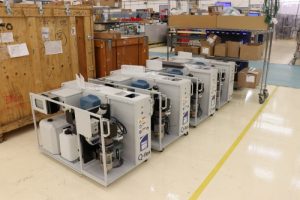
For complex OEM programs, vertical integration is especially important. A partner that can perform machining, sheet metal fabrication, welding, assembly, integration, testing, and inspection under one organization can often reduce handoffs and improve accountability.
How PEKO Supports Turnkey Manufacturing Services
PEKO provides turnkey manufacturing services for OEMs that need a contract manufacturing and assembly partner for complex machinery, equipment, assemblies, and integrated systems. Our vertically integrated capabilities allow customers to consolidate more of the production process with one experienced team. Depending on the program, PEKO can support:
- Engineering and manufacturability review
- BOM validation and sourcing support
- CNC machining
- Sheet metal fabrication
- Welding and finishing
- Mechanical and electromechanical assembly
- Integration and final testing
- Quality documentation and traceability
- Packaging and shipment
PEKO’s turnkey manufacturing support is built for OEMs that need more than individual parts. We help customers reduce supplier complexity, improve production control, and establish a more reliable path from technical requirements to completed builds.
 Download PEKO’s Contract Manufacturing Guide
If your team is deciding whether to keep sourcing individual parts or move to a turnkey manufacturing model, PEKO’s contract manufacturing guide can help you evaluate your options.
Download the guide to review key outsourcing considerations, supplier evaluation criteria, and the capabilities to look for when choosing a turnkey contract manufacturing partner for complex OEM equipment, assemblies, and systems.