


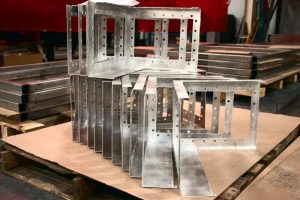
 Sheet metal bending at PEKO is built around automated panel bending for OEM parts that require repeatability, efficient setups, and reliable downstream fit. This process is well suited for covers, panels, cabinets, enclosures, and other enclosure-style components with multiple bends and recurring geometry.
Rather than treating bending as an isolated operation, PEKO supports it as part of a broader fabrication workflow that can include engineering, laser cutting, turret punching, welding, finishing, and assembly. That matters when bent parts need to move cleanly into the next operation and perform as intended in the final product.
Custom Sheet Metal Bending Services for Multi-Bend Sheet Metal Parts
PEKO’s precision sheet metal bending capability is centered on automated panel bending.
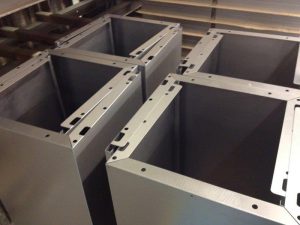
A panel bender, also called a CNC panel bender, is a good fit for parts with multiple bends, recurring flange geometry, and dimensional relationships that need to stay consistent from part to part.
For OEM products, that often includes formed components that must align with mating parts, accept hardware correctly, and maintain stable geometry through joining, finishing, and assembly.
When the part is a good fit for the process, CNC sheet metal bending can support repeatability, consistent bend geometry, and more efficient setups across repeat work.
What Is Panel Bending?
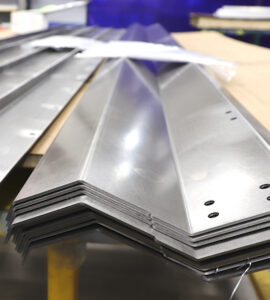
Panel bending is a form of sheet metal folding that uses an automated machine to clamp and form the workpiece through a controlled bending sequence. It is commonly used for parts that benefit from repeatable bend patterns and a stable forming process.
Compared with more general bending methods, automated panel bending can be especially useful when part geometry includes several bends and the finished part needs to hold its shape consistently through downstream operations. The process is often chosen for parts where bend quality, appearance, and downstream fit all matter.
When Panel Bending Is the Right Process
Panel bending is often the right choice when a part includes:
- Multiple bends that need to be formed consistently
- Repeat part families with similar geometry
- Large or enclosure-style profiles
- Cosmetic surfaces where variation is more noticeable
- Hardware locations or mating features affected by bend accuracy
- Production needs that benefit from efficient setups and repeatability
This makes panel bending a strong option for OEM programs where formed parts need to do more than meet a print. They also need to fit correctly within a larger assembly, move predictably through production, and support stable quality over time.
Common Sheet Metal Bending Applications
PEKO uses this process for sheet metal parts such as:
- Covers and access panels
- Cabinets and cabinet-like structures
- Equipment housings and enclosure panels
- Doors, skins, and formed outer panels
- Control-oriented fabricated panels
- Other multi-bend sheet metal parts used within larger fabricated assemblies
These parts are often part of a broader machine, enclosure, or electromechanical build rather than standalone piece-part work.
Why Downstream Fit Matters
A bent part still has to work in the next operation.
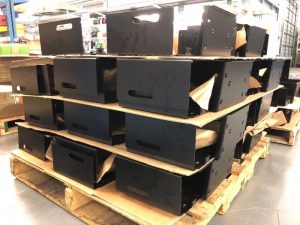
Hole-to-bend relationships, flange geometry, mating conditions, hardware access, weld locations, coating requirements, and final assembly all affect whether a formed part performs the way it should.
PEKO approaches complex sheet metal bending with those downstream requirements in view. That helps reduce avoidable fit-up issues later in the process and supports better alignment between forming, joining, finishing, and assembly.
For OEM products with tighter requirements, that connection between bend quality and downstream fit is often where process choice matters most.
Panel Bending vs. Press Brake Forming
Panel bending and press brake forming are both valuable sheet metal forming methods, but they are not the same fit for every part.
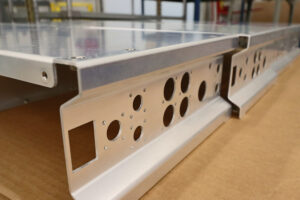
Sheet metal folding and panel bending is often a strong choice for covers, panels, cabinets, and other parts with multiple bends, recurring geometry, and a need for repeatability with consistent bend geometry.
It can also be attractive when efficient setups support smoother repeat production.
Press brake forming remains important for other part types, bend conditions, and production needs. For a broader overview of how these methods fit within PEKO’s capabilities, visit the sheet metal forming page.
PEKO’s Sheet Metal Bending Capability
PEKO supports this work with a RAS GIGAbend 76.30 10.5′ sheet metal folding system with 126″ x 130″ capacity. This capability is aligned to parts that benefit from automated panel bending, especially multi-bend sheet metal parts that require repeatability and controlled geometry.
As part of PEKO’s broader precision sheet metal fabrication operation, custom sheet metal bending services can be integrated with engineering review, cut-part preparation, welding, finishing, inspection, and assembly support. That gives OEM teams a more connected path from design refinement and transfer work into ongoing production.
Request a Quote for Sheet Metal Bending
If you are evaluating panel bending for covers, panels, cabinets, enclosures, or other formed components, PEKO can review your part geometry, quantities, and downstream requirements. Send your drawings, CAD files, material requirements, and target volumes to start the conversation.