

There is no single price for a product prototype. For complex machinery, equipment, and electromechanical products, prototype cost depends on the maturity of the design, the purpose of the build, and the engineering and manufacturing work required to produce useful hardware.
That is why the cost of prototyping a product is different from the price of a single prototype part. A complete build may include purchased components, custom-machined or fabricated parts, assembly, controls, system integration, testing, and engineering support.
The best place to start is not with a target price, but with a clear question: What does this prototype need to prove?
How Is Prototype Cost Estimated?
Prototype cost estimation starts with the current design package and the objective of the build. The more defined the product is when it enters prototype development, the easier it is to estimate the work required.
A mature package may include CAD models, drawings, a bill of materials (BOM), specifications, test requirements, and identified suppliers. Together, these inputs help clarify what needs to be engineered, purchased, manufactured, assembled, and tested. A well-developed BOM can also make high-cost or long-lead components easier to identify early.
From there, the estimate can account for engineering effort, purchased and custom components, outside processing, assembly and integration, inspection, testing, and any required tooling or fixtures. If significant product development engineering remains, or if key component selections and test requirements are still unresolved, that uncertainty can add engineering time and make the final prototype cost harder to predict.
What Goes into the Cost of a Prototype?
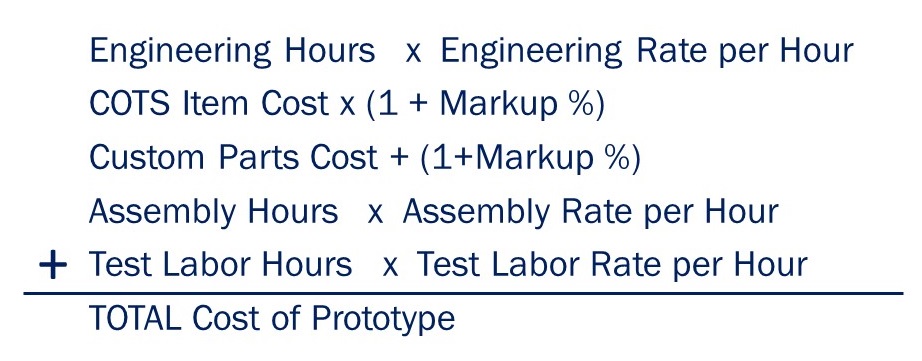
For complex hardware, the total product prototype cost is usually a combination of several cost categories rather than one manufacturing quote.
Engineering Labor
Engineering may be required before, during, and after the physical build. Typical work can include design refinement, CAD updates, drawings, tolerance analysis, test development, documentation, and support during assembly or troubleshooting.
Existing industry guidance often cites a broad planning range of $60–$200 per hour for U.S.-based engineering support. General engineering support may fall near the lower end of that range, while specialized engineering firms may charge closer to the higher end. Actual rates vary based on the type of work, required expertise, project complexity, and location.
The amount of unresolved work entering the build can have a significant effect on the overall product prototype cost.
Purchased & Custom Components
Most complex prototypes combine commercial off-the-shelf (COTS) components with custom hardware.
Motors, drives, sensors, bearings, controls components, power supplies, and similar items may be purchased. Frames, brackets, machined parts, sheet metal, enclosures, and precision interfaces may need to be manufactured specifically for the product.
Custom-part cost is influenced by material, complexity, tolerances, finishing, quantity, tooling, and lead time. Prototype part quantities also lack the economies of scale available in recurring production.
When a third party is responsible for sourcing outside components, procurement and material-management costs may also be included. As a planning assumption, externally purchased parts may carry a 12–25% markup.
Assembly & System Integration Labor
Parts only become a working prototype once they are assembled and integrated.
For most non-specialty machinery in the U.S., assembly labor is typically estimated at approximately $50–$150 per hour.
Prototype assembly can require experienced technicians because the hardware may expose issues with fit, access, wiring, routing, alignment, motion, or subsystem interfaces that have not yet been resolved in the design documentation.
For electromechanical equipment, integration may also involve controls, electrical systems, pneumatics, thermal hardware, and other subsystems. Those activities should be considered in the estimate rather than treated as incidental work after the components arrive.
Inspection & Prototype Testing
Prototype testing cost depends on what must be measured, how the test is performed, and how much engineering or technician involvement is required.
Some tests require direct engineering support, while others may run for hours with minimal hands-on labor. For example, an eight-hour test that requires only one hour of active monitoring may be estimated using one hour of labor.
Other expenses can include fixtures, instrumentation, data acquisition, consumables, outside laboratory services, or repeated test cycles.
How Prototype Maturity Changes the Budget
Not every prototype needs the same level of fidelity.
An early engineering build may only need to prove a mechanism, interface, or subsystem. Temporary structures, COTS components, alternate materials, or a partial build may be enough to answer the question.
As the design matures, later prototypes may need to represent more of the intended production configuration. That can mean more complete assemblies, production-intent materials, tighter requirements, better-defined controls, and more formal testing.
Higher fidelity can increase the cost of a prototype, but maturity affects the budget in another way as well. Earlier designs typically carry more technical uncertainty and may require additional build-test-refine cycles, while later builds may cost more individually but involve fewer unresolved design questions.
The goal is to match each build to the product’s current stage of development—using enough fidelity to answer the right questions without adding production-level detail before it is needed.
How to Control Prototype Cost Without Weakening the Build
The goal is not to make the cheapest possible prototype. It is to spend the budget where the build will produce useful engineering information.
Several decisions can have a meaningful effect on cost:
- Define what the prototype needs to prove. A clear build objective helps prevent unnecessary scope.
- Match the level of fidelity to that objective. Avoid adding production-level detail before it is needed.
- Use COTS components where appropriate. Custom hardware is not always necessary to answer the engineering question.
- Identify expensive custom components early. A small number of difficult or long-lead items may account for a significant percentage of the total prototype manufacturing cost.
- Avoid unnecessary tolerances and finishes. Specifications should support the build objective rather than add complexity without improving what can be learned.
- Review manufacturability before releasing parts. Early manufacturing input can expose features or requirements that add avoidable cost.
- Plan testing before the build. Fixtures, access, instrumentation, and test points can affect both design and budget.
- Use subsystem builds when appropriate. A complete machine is not always required to resolve a specific technical question.
- Keep drawings, BOMs, and specifications current. Changes from one build should be reflected in the information used to plan and estimate the next iteration.
These choices are less about cutting corners and more about making sure prototype dollars are spent on the features and hardware that reduce meaningful technical uncertainty.
How to Compare Prototype Cost Estimates
A useful prototype estimate should make the scope behind the number clear.
When reviewing an estimate, look at what is included for engineering, purchased components, custom manufacturing, outside processing, assembly, integration, inspection, and testing. Just as important, understand the assumptions and exclusions behind those numbers.
A quote based on released drawings and a stable BOM is not directly comparable to one prepared while component selection, interfaces, or test requirements are still changing.
The lowest initial number may not represent the lowest total program cost if important work has been excluded or left undefined. For complex hardware, understanding what the estimate covers is often more useful than comparing totals alone.
Prototype Cost FAQs
How much does it cost to make a prototype?
There is no universal figure. The cost of a prototype depends on product complexity, design maturity, purchased and custom components, manufacturing requirements, engineering effort, assembly, testing, and the number of iterations required.
A complete electromechanical machine will generally have a very different cost structure from a single prototype component because the machine requires multiple disciplines and activities to create functioning hardware.
Why can prototype parts cost more than production parts?
Prototype quantities spread programming, setup, tooling, inspection, and other fixed costs across only one or a few parts. Prototype components may also be ordered on shorter schedules or undergo design changes that require additional setup and manufacturing work.
Do later prototype builds always cost more?
No. Later builds may contain more production-intent hardware, but they may also require less engineering as the design stabilizes. Cost depends on what changes and what the next build needs to prove.
Planning a Prototype Budget for Complex Hardware
A useful prototype budget accounts for more than the hardware itself. Engineering, sourcing, manufacturing, assembly, system integration, inspection, testing, and iteration can all affect the final prototype cost.
The clearer the build objective and the more mature the design, the easier it becomes to estimate those requirements and decide where prototype spending will provide the most value.
PEKO supports prototype development for complex mechanical, electrical, and electromechanical products as part of broader new product introduction programs, helping OEM teams carry what is learned in the build into the next stage of development.
Contact our team to start discussing your prototype program by submitting the form below: