

Industrial power supplies convert incoming power into the regulated voltages required by PLCs, HMIs, sensors, machine vision systems, relays, communication devices, actuators, and other control components.
Although they may appear to be simple bill-of-material items, their selection can affect equipment uptime, enclosure size, thermal performance, electromagnetic compatibility, serviceability, and long-term availability. The supply must meet its electrical requirements and operate reliably within the complete architecture of the industrial equipment or automation system.
This guide reviews the most common industrial power supply types and the primary considerations involved in selecting and integrating them into OEM equipment.
What Does an Industrial Power Supply Do?
In many applications, a power supply converts facility-level AC power into regulated DC power. A machine may receive 120 VAC, 208 VAC, or 240 VAC and use one or more supplies to provide 24 VDC, 12 VDC, 48 VDC, or another output voltage to its control system.
They are used throughout industrial equipment and automation systems, including automated assembly, inspection and test, semiconductor, medical, energy, packaging, and robotic equipment. The correct supply depends on the connected loads, operating environment, applicable safety requirements, and expected service life of the equipment.
Common Types of Industrial Power Supplies
Switching Power Supplies
Switching power supplies, or switch-mode power supplies, use high-frequency switching electronics to regulate power. Compared with traditional linear supplies, they generally offer higher efficiency, smaller size, lower weight, and reduced heat generation.
They are common in control panels and electromechanical equipment and are available in DIN rail, chassis-mounted, enclosed, and open-frame configurations. Features may include overload protection, adjustable output voltage, or diagnostic contacts.
Because switching supplies operate at high frequencies, grounding, filtering, and cable routing must be considered carefully to reduce electrical noise.
DIN Rail Power Supplies
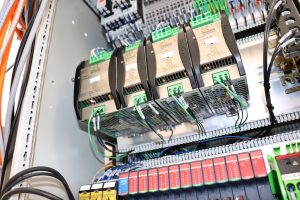
DIN rail power supplies mount on standardized metal rails inside electrical enclosures. They support modular panel layouts and make components easier to install, replace, and service.
Typical loads include PLCs, HMIs, sensors, relays, safety devices, communication equipment, and machine vision components. When selecting a DIN rail supply, engineers should account for available rail space, airflow, terminal access, wiring clearances, and proximity to heat-producing components.
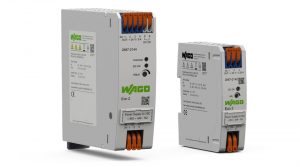
DIN rail power supplies are available in increasingly compact formats. For example, WAGO Eco 2 power supplies use tool-free lever connections and a narrow design intended to conserve control-cabinet space.
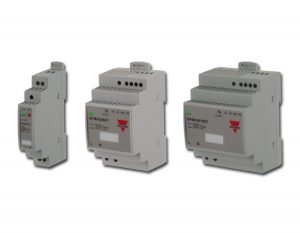
The Carlo Gavazzi SPMA series includes compact switching supplies with overload, short-circuit, and overvoltage protection.
Although smaller footprints can support more efficient panel layouts, size should be evaluated alongside load capacity, thermal performance, required certifications, connection requirements, and long-term product availability.
Industrial DC Power Supplies
Industrial DC power supplies provide regulated direct-current output. Common outputs include 5 VDC, 12 VDC, 24 VDC, 36 VDC, and 48 VDC.
Twenty-four-volt DC power is especially common because it is supported by many PLCs, sensors, relays, solenoids, safety components, and communication devices.
A machine may use one centralized supply or several supplies divided by subsystem. Separate supplies can improve fault isolation, reduce electrical noise, and simplify troubleshooting, but they also add wiring, components, and panel-space requirements.
Medical Power Supplies
Medical electrical equipment may require power supplies designed for additional safety, isolation, and leakage-current requirements. Engineers may need to evaluate input-to-output isolation, dielectric strength, means of operator or patient protection, electromagnetic compatibility, and component traceability.
The IEC 60601-1 standard addresses general requirements for the basic safety and essential performance of medical electrical equipment.
A medical-rated supply can support compliance, but the finished device must still be evaluated based on its architecture, enclosure, grounding, and intended use.
Key Power Supply Selection Considerations
Power supply selection should begin with a documented understanding of the machine’s electrical loads and operating environment.
Engineers should review the power supply manufacturers complete specifications, including input and output ratings, line and load regulation, ripple, current limits, and temperature derating.
Input & Output Requirements
Confirm the available input voltage, phase, frequency, permitted voltage range, and regional installation requirements. The output voltage must match the connected components. Systems requiring several voltages may use multiple AC-to-DC supplies, DC-to-DC converters, or isolated branches.
Continuous & Peak Loads
The continuous load calculation should include all devices expected to operate at the same time, including controls, sensors, communication devices, lighting, brakes, and actuators.
Peak current also matters. Motors, solenoids, capacitive loads, and lighting may draw significantly more current during startup or actuation than during steady operation. A supply that appears adequate based only on continuous current may enter current limiting or shut down during peak demand.
Capacity, Environment, & Approvals
Some capacity margin may be appropriate for component tolerances, future revisions, or added loads, but excessive oversizing can increase cost, panel space, and inrush current.
The supply should also be evaluated for actual enclosure conditions, including temperature, humidity, dust, vibration, altitude, washdown exposure, or hazardous-location requirements. Cabinet temperature may be much higher than room temperature.
Depending on the application and target market, relevant approvals may include UL, CSA, CE, IEC, medical, or hazardous-location requirements.
Product Availability
Because OEM equipment may remain in service for years, power supply selection should also consider manufacturer support, lead times, approved alternates, and obsolescence notifications. A future substitution can affect mounting, wiring, thermal behavior, certifications, and testing.
Redundancy & Reliability
Power supply redundancy can reduce the risk that a single failure will shut down critical equipment.
In a 1+1 system, either of two supplies can support the full load. In an N+1 configuration, the system includes the number of supplies required for normal operation plus one additional unit.
Compatible supplies may also be operated in parallel for additional current, but parallel operation is not automatically the same as redundancy. If one supply fails, the remaining units must still support the required load.
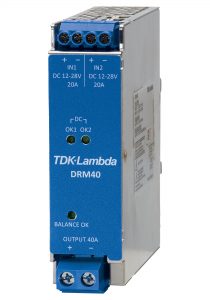
A redundancy or ORing module can isolate supplies and prevent a fault in one branch from pulling down the entire DC bus. The TDK-Lambda DRM40 series includes DIN rail redundancy modules with current-balance indication and input-status signaling.
OEM teams should determine whether the remaining supply can carry the load, how a failure will be detected, whether the PLC or HMI will generate an alarm, and how the system will be tested and serviced.
Thermal Management
Power supplies generate heat, and their available output may decrease as enclosure temperatures rise. Power supply manufacturers commonly publish derating curves showing how output capacity changes with temperature, input voltage, altitude, or mounting orientation.
Thermal design should account for actual cabinet temperature, nearby heat-producing components, airflow, required clearances, enclosure size, cooling, and equipment duty cycle.
A supply that performs adequately at room temperature may not provide the same output inside a sealed enclosure next to servo drives or contactors. Higher temperatures can also reduce component life.
For equipment where uptime is critical, the design may require a higher-efficiency supply, additional capacity, improved cabinet cooling, or redundancy.
EMC & Electrical Noise
Electromagnetic compatibility refers to the ability of equipment to operate correctly without creating or receiving unacceptable interference.
Improperly integrated switching supplies can contribute to sensor errors, communication faults, unstable analog signals, PLC resets, machine vision artifacts, or emissions-test failures.
Common practices include:
- Following manufacturer grounding recommendations
- Correctly bonding the enclosure and protective earth
- Separating sensitive wiring from motor and high-current circuits
- Using input filters where required
- Providing dedicated branches for noise-sensitive devices
A component-level EMC rating does not guarantee that the complete machine will meet system-level requirements. The final result also depends on enclosure design, grounding, wiring layout, motors, drives, filters, and connected peripherals.
Integrating Industrial Power Supplies into OEM Equipment
Successful integration requires coordination between the power architecture, panel layout, wiring documentation, bill of materials, assembly process, and test plan.
An OEM may specify the exact power supply manufacturer and model. In other cases, the controls and manufacturing teams may help evaluate the most appropriate option.
Integration activities can include:
- DIN rail or chassis mounting
- Input and output wiring
- Circuit protection and DC distribution
- Grounding and bonding
- Redundancy module installation
- Diagnostic and alarm wiring
- Electrical inspection
- Functional testing and troubleshooting
Testing should confirm more than nominal output voltage. It may include startup, peak-load, fault, redundancy, and thermal testing, plus verification of PLC or HMI alarms.
For production programs, the process should be supported by controlled bills of materials, work instructions, wiring standards, inspection requirements, and repeatable test procedures.
Industrial Power Supply Manufacturers
PEKO has experience integrating power supplies from manufacturers including Delta Electronics, Allen-Bradley and Rockwell Automation, Phoenix Contact, and PULS.
Other power supply manufacturers serving the industrial market include WAGO, Carlo Gavazzi, and TDK-Lambda.
No single manufacturer or product family is appropriate for every OEM program. Selection should be based on documented performance, environmental, compliance, and lifecycle requirements.
Industrial Power Supply Integration at PEKO
PEKO routinely integrates customer-specified industrial power supplies during electromechanical equipment manufacturing and complex electromechanical assembly.
When an OEM has already selected the required manufacturer and model, PEKO can procure and install the component according to the approved bill of materials. When additional support is needed, PEKO’s controls engineering team can help evaluate the type and number of supplies required within the broader control-system architecture.
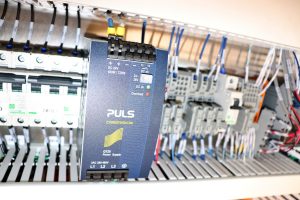 Depending on the program, PEKO’s scope may include installation, control-panel assembly, wiring, circuit protection, cable and harness integration, PLC and HMI connections, electrical inspection, functional testing, troubleshooting, and production documentation.
PEKO has successfully installed and tested industrial power supplies in tens of thousands of systems. Programs can range from a limited number of prototype machines to hundreds of production units.
Power supply integration is typically one element of a larger custom machine building, automation equipment manufacturing, or electromechanical equipment program.
PEKO’s role is to help OEM customers integrate, test, and scale complete equipment—not to manufacture the industrial power supply itself.
Planning Power Integration for Your OEM Equipment
Industrial power supply selection should be considered as part of the complete architecture of the industrial equipment or automation system. Voltage, load requirements, peak current, thermal conditions, redundancy, EMC, component availability, panel layout, and production testing can all affect reliability of the finished machine.
Whether the power supply has already been specified or the electrical architecture requires additional review, PEKO can support installation, wiring, testing, and production integration for industrial automation and other OEM equipment programs.